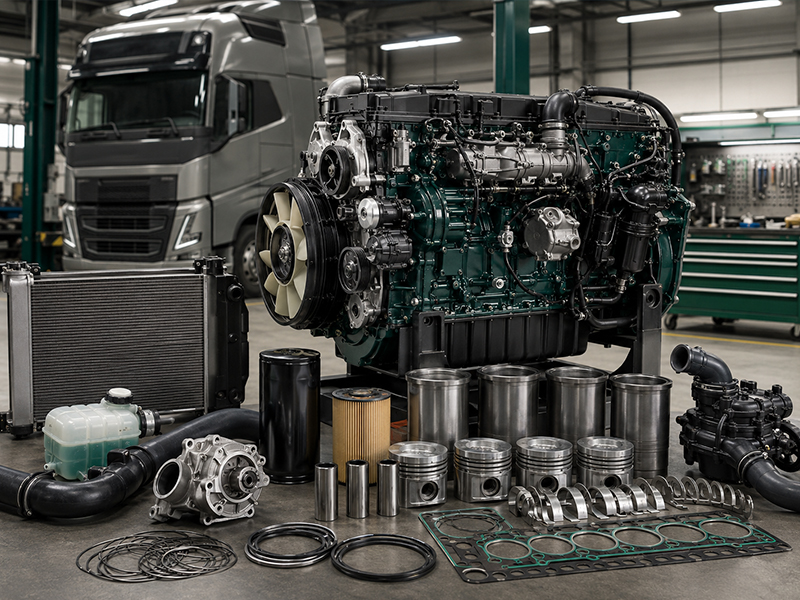
Volvo truck Engine Parts: Overhaul, Lubrication and Cooling Guide
A practical guide to pistons, rings, cylinder liners, bearings, gaskets, oil pumps, water pumps, thermostats and oil coolers for Volvo truck applications, including OEM verification, symptoms and quotation details.Selecting the correct parts for Volvo truck applications affects performance, safety, fuel efficiency and operational continuity. The primary SEO phrase for this guide is Volvo truck spare parts, supported naturally by Volvo truck parts. The purpose is not simply to locate a product, but to help the buyer prepare reliable technical information and confirm compatibility before an order is approved.
The main product scope covers pistons, rings, cylinder liners, bearings, gaskets, oil pumps, water pumps, thermostats and oil coolers. Vehicles or engines within the same brand and application can use different engine, transmission, electrical or control-system configurations, so appearance alone is not a dependable selection method. The OEM part number, production information, serial number or VIN, technical dimensions and clear photographs of the existing component should be evaluated together.
Before requesting a quotation from PruvaPort, confirm the source of the reported problem rather than assuming that the most visible component has failed. Low oil pressure, overheating, oil consumption, compression loss or abnormal engine noise can also result from a related part or connection. The following sections provide a practical path from diagnosis and identification to quotation preparation, installation and post-repair checks.
Most frequently replaced engine overhaul parts
Cylinder head and gasket set
A search for Volvo truck spare parts in relation to “Most frequently replaced engine overhaul parts” requires more than identifying a component by its common name. In Volvo truck applications, pistons, rings, cylinder liners, bearings, gaskets, oil pumps, water pumps, thermostats and oil coolers may be supplied with different dimensions, connections and operating ratings within the same product family. The number on the existing unit, the VIN, engine code, production year and system identification plate and the catalogue application must therefore be reviewed together. Careful identification reduces unnecessary dismantling, incorrect orders and avoidable vehicle or vessel downtime.
When assessing Cylinder head and gasket set, the first task is to confirm the source of the fault. Low oil pressure, overheating, oil consumption, compression loss or abnormal engine noise may not point to one component only; a connection, supply, sensor, fluid condition or neighbouring system can create a similar symptom. Replacing parts before measurements and diagnosis are complete can conceal the underlying cause. Service history, fault codes, pressure or voltage readings and the physical inspection should be considered as one evidence set.
An OEM reference is a strong starting point for compatibility, but it is not always sufficient by itself. An older reference may have been superseded, an apparently identical housing may contain a different specification, or the component may have changed during a production period. Confirmation against the VIN, engine code, production year and system identification plate is recommended. Product-specific details such as connector layout, flange, thread, diameter, length, pressure, voltage and installation side should also be compared.
Crankshaft and connecting-rod bearings
The service life of a Volvo truck system depends on installation quality as well as the replacement component. Clean mating surfaces, correct torque, suitable seals and fluids, bleeding procedures and any required calibration must not be overlooked. Reusing worn fasteners or introducing an incompatible lubricant or coolant may damage the new part prematurely. Installation should follow the applicable manufacturer procedure and safety requirements and should be carried out by qualified personnel.
Operating conditions influence the purchasing decision directly. Factors including payload, route profile, gradients, long-distance mileage and operating temperature can change the expected service interval and material requirement. For equipment in intensive service, purchase price should be assessed alongside expected life, warranty, lead time and the cost of repeat labour. For critical systems, products with unclear technical data should be avoided, while manufacturer, origin, quality standard and package information should be recorded for traceability.
A quotation request should include the term Volvo truck parts, required quantity, destination country, preferred quality level and clear photographs of the existing component. If the label does not provide enough information, include the overall shape, mounting points, connections and relevant measurements. Internal links from this guide to the corresponding PruvaPort category can help users move from research to product selection. Final order approval should always be based on a verified OEM reference and technical compatibility.
Lubrication system parts and failure symptoms
Pistons, rings and liners
A search for Volvo truck spare parts in relation to “Lubrication system parts and failure symptoms” requires more than identifying a component by its common name. In Volvo truck applications, pistons, rings, cylinder liners, bearings, gaskets, oil pumps, water pumps, thermostats and oil coolers may be supplied with different dimensions, connections and operating ratings within the same product family. The number on the existing unit, the VIN, engine code, production year and system identification plate and the catalogue application must therefore be reviewed together. Careful identification reduces unnecessary dismantling, incorrect orders and avoidable vehicle or vessel downtime.
When assessing Pistons, rings and liners, the first task is to confirm the source of the fault. Low oil pressure, overheating, oil consumption, compression loss or abnormal engine noise may not point to one component only; a connection, supply, sensor, fluid condition or neighbouring system can create a similar symptom. Replacing parts before measurements and diagnosis are complete can conceal the underlying cause. Service history, fault codes, pressure or voltage readings and the physical inspection should be considered as one evidence set.
An OEM reference is a strong starting point for compatibility, but it is not always sufficient by itself. An older reference may have been superseded, an apparently identical housing may contain a different specification, or the component may have changed during a production period. Confirmation against the VIN, engine code, production year and system identification plate is recommended. Product-specific details such as connector layout, flange, thread, diameter, length, pressure, voltage and installation side should also be compared.
Oil pump and filters
The service life of a Volvo truck system depends on installation quality as well as the replacement component. Clean mating surfaces, correct torque, suitable seals and fluids, bleeding procedures and any required calibration must not be overlooked. Reusing worn fasteners or introducing an incompatible lubricant or coolant may damage the new part prematurely. Installation should follow the applicable manufacturer procedure and safety requirements and should be carried out by qualified personnel.
Operating conditions influence the purchasing decision directly. Factors including payload, route profile, gradients, long-distance mileage and operating temperature can change the expected service interval and material requirement. For equipment in intensive service, purchase price should be assessed alongside expected life, warranty, lead time and the cost of repeat labour. For critical systems, products with unclear technical data should be avoided, while manufacturer, origin, quality standard and package information should be recorded for traceability.
A quotation request should include the term Volvo truck parts, required quantity, destination country, preferred quality level and clear photographs of the existing component. If the label does not provide enough information, include the overall shape, mounting points, connections and relevant measurements. Internal links from this guide to the corresponding PruvaPort category can help users move from research to product selection. Final order approval should always be based on a verified OEM reference and technical compatibility.
Cooling system components and overheating causes
Crankshaft and connecting-rod bearings
A search for Volvo truck spare parts in relation to “Cooling system components and overheating causes” requires more than identifying a component by its common name. In Volvo truck applications, pistons, rings, cylinder liners, bearings, gaskets, oil pumps, water pumps, thermostats and oil coolers may be supplied with different dimensions, connections and operating ratings within the same product family. The number on the existing unit, the VIN, engine code, production year and system identification plate and the catalogue application must therefore be reviewed together. Careful identification reduces unnecessary dismantling, incorrect orders and avoidable vehicle or vessel downtime.
When assessing Crankshaft and connecting-rod bearings, the first task is to confirm the source of the fault. Low oil pressure, overheating, oil consumption, compression loss or abnormal engine noise may not point to one component only; a connection, supply, sensor, fluid condition or neighbouring system can create a similar symptom. Replacing parts before measurements and diagnosis are complete can conceal the underlying cause. Service history, fault codes, pressure or voltage readings and the physical inspection should be considered as one evidence set.
An OEM reference is a strong starting point for compatibility, but it is not always sufficient by itself. An older reference may have been superseded, an apparently identical housing may contain a different specification, or the component may have changed during a production period. Confirmation against the VIN, engine code, production year and system identification plate is recommended. Product-specific details such as connector layout, flange, thread, diameter, length, pressure, voltage and installation side should also be compared.
Water pump, thermostat and radiator
The service life of a Volvo truck system depends on installation quality as well as the replacement component. Clean mating surfaces, correct torque, suitable seals and fluids, bleeding procedures and any required calibration must not be overlooked. Reusing worn fasteners or introducing an incompatible lubricant or coolant may damage the new part prematurely. Installation should follow the applicable manufacturer procedure and safety requirements and should be carried out by qualified personnel.
Operating conditions influence the purchasing decision directly. Factors including payload, route profile, gradients, long-distance mileage and operating temperature can change the expected service interval and material requirement. For equipment in intensive service, purchase price should be assessed alongside expected life, warranty, lead time and the cost of repeat labour. For critical systems, products with unclear technical data should be avoided, while manufacturer, origin, quality standard and package information should be recorded for traceability.
A quotation request should include the term Volvo truck parts, required quantity, destination country, preferred quality level and clear photographs of the existing component. If the label does not provide enough information, include the overall shape, mounting points, connections and relevant measurements. Internal links from this guide to the corresponding PruvaPort category can help users move from research to product selection. Final order approval should always be based on a verified OEM reference and technical compatibility.
Selecting gaskets, rings, pistons and bearings
Oil pump and filters
A search for Volvo truck spare parts in relation to “Selecting gaskets, rings, pistons and bearings” requires more than identifying a component by its common name. In Volvo truck applications, pistons, rings, cylinder liners, bearings, gaskets, oil pumps, water pumps, thermostats and oil coolers may be supplied with different dimensions, connections and operating ratings within the same product family. The number on the existing unit, the VIN, engine code, production year and system identification plate and the catalogue application must therefore be reviewed together. Careful identification reduces unnecessary dismantling, incorrect orders and avoidable vehicle or vessel downtime.
When assessing Oil pump and filters, the first task is to confirm the source of the fault. Low oil pressure, overheating, oil consumption, compression loss or abnormal engine noise may not point to one component only; a connection, supply, sensor, fluid condition or neighbouring system can create a similar symptom. Replacing parts before measurements and diagnosis are complete can conceal the underlying cause. Service history, fault codes, pressure or voltage readings and the physical inspection should be considered as one evidence set.
An OEM reference is a strong starting point for compatibility, but it is not always sufficient by itself. An older reference may have been superseded, an apparently identical housing may contain a different specification, or the component may have changed during a production period. Confirmation against the VIN, engine code, production year and system identification plate is recommended. Product-specific details such as connector layout, flange, thread, diameter, length, pressure, voltage and installation side should also be compared.
Cylinder head and gasket set
The service life of a Volvo truck system depends on installation quality as well as the replacement component. Clean mating surfaces, correct torque, suitable seals and fluids, bleeding procedures and any required calibration must not be overlooked. Reusing worn fasteners or introducing an incompatible lubricant or coolant may damage the new part prematurely. Installation should follow the applicable manufacturer procedure and safety requirements and should be carried out by qualified personnel.
Operating conditions influence the purchasing decision directly. Factors including payload, route profile, gradients, long-distance mileage and operating temperature can change the expected service interval and material requirement. For equipment in intensive service, purchase price should be assessed alongside expected life, warranty, lead time and the cost of repeat labour. For critical systems, products with unclear technical data should be avoided, while manufacturer, origin, quality standard and package information should be recorded for traceability.
A quotation request should include the term Volvo truck parts, required quantity, destination country, preferred quality level and clear photographs of the existing component. If the label does not provide enough information, include the overall shape, mounting points, connections and relevant measurements. Internal links from this guide to the corresponding PruvaPort category can help users move from research to product selection. Final order approval should always be based on a verified OEM reference and technical compatibility.
Compatibility checks using the engine code
Water pump, thermostat and radiator
A search for Volvo truck spare parts in relation to “Compatibility checks using the engine code” requires more than identifying a component by its common name. In Volvo truck applications, pistons, rings, cylinder liners, bearings, gaskets, oil pumps, water pumps, thermostats and oil coolers may be supplied with different dimensions, connections and operating ratings within the same product family. The number on the existing unit, the VIN, engine code, production year and system identification plate and the catalogue application must therefore be reviewed together. Careful identification reduces unnecessary dismantling, incorrect orders and avoidable vehicle or vessel downtime.
When assessing Water pump, thermostat and radiator, the first task is to confirm the source of the fault. Low oil pressure, overheating, oil consumption, compression loss or abnormal engine noise may not point to one component only; a connection, supply, sensor, fluid condition or neighbouring system can create a similar symptom. Replacing parts before measurements and diagnosis are complete can conceal the underlying cause. Service history, fault codes, pressure or voltage readings and the physical inspection should be considered as one evidence set.
An OEM reference is a strong starting point for compatibility, but it is not always sufficient by itself. An older reference may have been superseded, an apparently identical housing may contain a different specification, or the component may have changed during a production period. Confirmation against the VIN, engine code, production year and system identification plate is recommended. Product-specific details such as connector layout, flange, thread, diameter, length, pressure, voltage and installation side should also be compared.
Pistons, rings and liners
The service life of a Volvo truck system depends on installation quality as well as the replacement component. Clean mating surfaces, correct torque, suitable seals and fluids, bleeding procedures and any required calibration must not be overlooked. Reusing worn fasteners or introducing an incompatible lubricant or coolant may damage the new part prematurely. Installation should follow the applicable manufacturer procedure and safety requirements and should be carried out by qualified personnel.
Operating conditions influence the purchasing decision directly. Factors including payload, route profile, gradients, long-distance mileage and operating temperature can change the expected service interval and material requirement. For equipment in intensive service, purchase price should be assessed alongside expected life, warranty, lead time and the cost of repeat labour. For critical systems, products with unclear technical data should be avoided, while manufacturer, origin, quality standard and package information should be recorded for traceability.
A quotation request should include the term Volvo truck parts, required quantity, destination country, preferred quality level and clear photographs of the existing component. If the label does not provide enough information, include the overall shape, mounting points, connections and relevant measurements. Internal links from this guide to the corresponding PruvaPort category can help users move from research to product selection. Final order approval should always be based on a verified OEM reference and technical compatibility.
Maintenance and post-installation checks
Cylinder head and gasket set
A search for Volvo truck spare parts in relation to “Maintenance and post-installation checks” requires more than identifying a component by its common name. In Volvo truck applications, pistons, rings, cylinder liners, bearings, gaskets, oil pumps, water pumps, thermostats and oil coolers may be supplied with different dimensions, connections and operating ratings within the same product family. The number on the existing unit, the VIN, engine code, production year and system identification plate and the catalogue application must therefore be reviewed together. Careful identification reduces unnecessary dismantling, incorrect orders and avoidable vehicle or vessel downtime.
When assessing Cylinder head and gasket set, the first task is to confirm the source of the fault. Low oil pressure, overheating, oil consumption, compression loss or abnormal engine noise may not point to one component only; a connection, supply, sensor, fluid condition or neighbouring system can create a similar symptom. Replacing parts before measurements and diagnosis are complete can conceal the underlying cause. Service history, fault codes, pressure or voltage readings and the physical inspection should be considered as one evidence set.
An OEM reference is a strong starting point for compatibility, but it is not always sufficient by itself. An older reference may have been superseded, an apparently identical housing may contain a different specification, or the component may have changed during a production period. Confirmation against the VIN, engine code, production year and system identification plate is recommended. Product-specific details such as connector layout, flange, thread, diameter, length, pressure, voltage and installation side should also be compared.
Crankshaft and connecting-rod bearings
The service life of a Volvo truck system depends on installation quality as well as the replacement component. Clean mating surfaces, correct torque, suitable seals and fluids, bleeding procedures and any required calibration must not be overlooked. Reusing worn fasteners or introducing an incompatible lubricant or coolant may damage the new part prematurely. Installation should follow the applicable manufacturer procedure and safety requirements and should be carried out by qualified personnel.
Operating conditions influence the purchasing decision directly. Factors including payload, route profile, gradients, long-distance mileage and operating temperature can change the expected service interval and material requirement. For equipment in intensive service, purchase price should be assessed alongside expected life, warranty, lead time and the cost of repeat labour. For critical systems, products with unclear technical data should be avoided, while manufacturer, origin, quality standard and package information should be recorded for traceability.
A quotation request should include the term Volvo truck parts, required quantity, destination country, preferred quality level and clear photographs of the existing component. If the label does not provide enough information, include the overall shape, mounting points, connections and relevant measurements. Internal links from this guide to the corresponding PruvaPort category can help users move from research to product selection. Final order approval should always be based on a verified OEM reference and technical compatibility.
Quotation Checklist
Correct Volvo truck spare parts selection depends on combining the OEM reference, technical dimensions, VIN and engine code and operating conditions. Adding component photographs, quantity, destination country and preferred quality level to the enquiry supports faster matching. Diagnosis and installation of safety-critical or internal engine components should be completed by qualified service personnel.
